New Discovery Unveiled: Prehistoric Vehicle Tracks Rewrite Human Migration History
In a groundbreaking discovery, scientists have uncovered prehistoric vehicle tracks that shed light on the timeline of human migration. The remarkable finding, made by a team from Bournemouth University in White Sands National Park, New Mexico, has ignited a new understanding of our ancient ancestors’ mobility.
The world’s first vehicles date back some 20,000 years, challenging previous beliefs about the early use of such technology. The drag marks discovered alongside human footprints in the national park have opened a window into the past, revealing a complex tapestry of human movement and innovation.
Unveiling Ancient Transport Technology
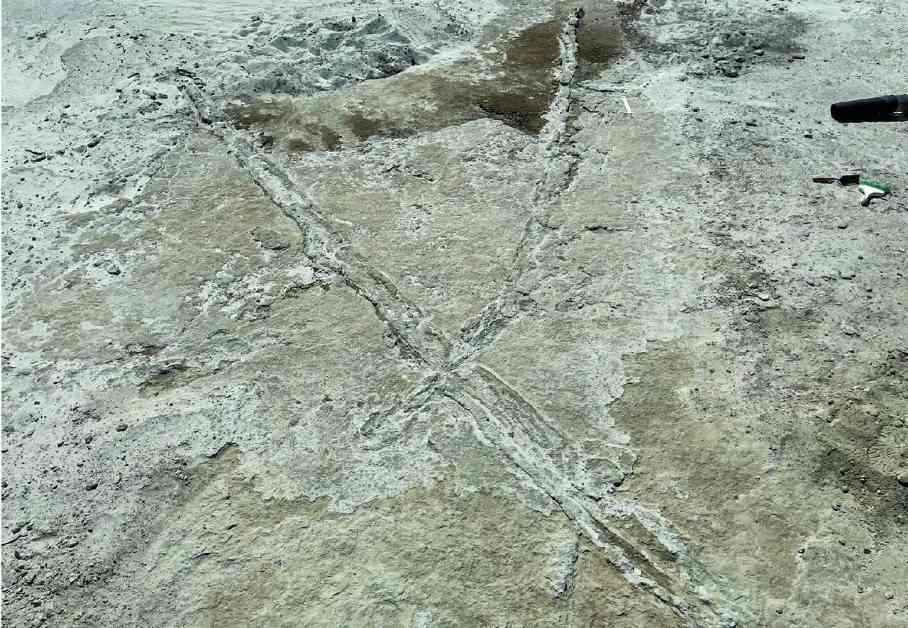
The tracks, preserved in dried mud and buried under sediment, offer a glimpse into a primitive transport device known as a travois. Consisting of two wooden poles tied together, this simple yet ingenious contraption was used by Indigenous people from the Americas to transport goods. The discovery suggests that this technology emerged much earlier than previously thought, hinting at the resourcefulness and adaptability of our ancient forebears.
Matthew Bennett, a co-author of the study, emphasized the significance of this find, stating, “We know that our earliest ancestors must have used some form of transport to carry their possessions as they migrated around the world, but evidence in the form of wooden vehicles has rotted away.” The drag marks left by the travois provide a tangible link to our past, offering insights into how early humans navigated their environments long before the advent of wheeled vehicles.
The identification of X-shaped travois tracks, some stretching up to 165 feet, coupled with the presence of varying footprints indicating a group that included children, paints a vivid picture of ancient migration. Bennett likened the scene to a modern family pushing a shopping cart, drawing a relatable parallel between past and present modes of transporting goods.
Testing and Verification of Findings
To corroborate their discovery, Bennett and his team conducted experiments by dragging replica travois across mudflats in Dorset, United Kingdom, and along the coast of Maine, in the northeastern United States. These tests confirmed that the mud tracks left by the travois matched the prehistoric markings found at White Sands National Park, validating the authenticity of the ancient vehicle tracks.
While previous research had uncovered human footprints dating back 23,000 years, the prevailing belief was that humans entered the North American continent around 15,000 years ago. However, the revelation of travois marks in New Mexico has challenged this timeline, suggesting that human migration may have commenced thousands of years earlier than previously assumed.
Sally Reynolds, a co-author of the study and a paleontologist at Bournemouth University, underscored the importance of these findings in piecing together the puzzle of early human migration. “Every discovery at White Sands adds to our understanding of the lives of the first people to settle in the Americas,” Reynolds remarked. “These people were the first migrants to travel to North America, and understanding more about how they moved around is vital to telling their story.”
As the veil of history is slowly lifted, each new revelation brings us closer to unraveling the mysteries of our ancient past. The intricate dance of human migration, as evidenced by these prehistoric vehicle tracks, serves as a poignant reminder of our shared journey through time and space.